Culture is not something extra. It is how students learn to belong.
At Common Grounds, school culture is part of how students learn what it means to belong, participate, and matter in a community. This section of our team's design paper addresses how we build that culture — from daily rituals to behavioral frameworks.
Shared Rituals, Routines, and Community-Building Structures
At Common Grounds, school culture is not something extra we build after academics are done. It is part of how students learn what it means to belong, participate, and matter in a community. If our mission is really about students becoming self-directed, critically engaged meaning-makers, then the school has to feel human from the moment they walk in. That means shared rituals and routines cannot just be about compliance, attendance, or keeping order. They have to help students feel known, grounded, and connected by a community with roots and a trajectory to grow.
That is why we have built the school day around repeated community practices that are both welcoming and purposeful. Every morning would begin with a short schoolwide announcement that helps orient students to the day, highlights upcoming events, and reinforces the values of the school. One of the recurring phrases in that announcement would be, 'Make it a great day or not, the choice is yours.' In our school, that line is not about fake positivity. It is about agency. Students may not control everything happening around them, but they should feel that they still have a role in how they show up, how they respond, and an accessible path they contribute to in space around them.
This kind of daily ritual is imperative because it helps create consistency, but it also says something bigger: school is a shared public space, and everyone in it helps shape the tone. Dewey (1916) argued that schools should function as democratic communities, not simply places where information is delivered, and that idea is central here. We want students to experience school as something they are actively part of, not something being done to them. Noddings (2005) also reminds us that care is not peripheral to education; it is one of the conditions that makes meaningful education possible in the first place. For that reason, our routines have to do more than organize bodies. They need to establish communicative care, expectation, and a common ground.
These rituals would also include schoolwide acknowledgments of identity and culture. Heritage and history months such as Hispanic Heritage Month, Black History Month, Women's History Month, Asian American and Pacific Islander Heritage Month, and Pride-related celebrations would be visible in the life of the school through assemblies, family nights, student exhibitions, and classroom connections. This reflects Ladson-Billings's (1995) insistence that teaching should support academic success while also affirming cultural identity and building critical consciousness, as well as Hammond's (2015) argument that learning is tied to culture, cognition, and trust. If students do not see themselves, their histories, or their communities treated as worthy of study, school quietly teaches them that legitimacy belongs elsewhere.
Because of this, community-building events at Common Grounds would be intentionally public and student-facing. Open house nights are no longer parents quietly walking through hallways; they would be opportunities for families to see student work, hear student presentations, and understand how the school functions. Albany Inquiry Days, student-led exhibitions, media arts festivals, and college and community fairs would reinforce that the school is not isolated from the city around it. Freire (1970) argued that education should help students read the word and the world together. That is exactly the kind of culture we want: one where school life is tied to real communities, real questions, and real participation that leads to inquiry and engagement with the future.
Common Ground Communities and Daily Community Practice
Rather than using a traditional homeroom only for attendance and announcements, Common Grounds organizes students into Common Ground Communities — small advisory-based groups that act as a home base socially, academically, and emotionally. Students join a Common Ground Community in ninth grade and, whenever possible, stay with that same advisor and peer group through twelfth grade. This matters deeply to our mission for anchoring community engagement. High school students should not have to start over every year with adults who barely know them. If we want meaningful support, honest reflection, and long-term transition planning, then students need sustained relationships.
This model reflects Vygotsky's (1978) idea that learning is social and develops through relationships with more knowledgeable others. It also reflects Noddings's (2005) view that schools must be organized around care and relational trust if they are going to support students in real ways. In practical terms, it means that advisory becomes the place where students check in, greet each other, talk through concerns, reflect on growth, and develop a sense of belonging that is not tied only to performance. It is also where they come to understand that they are not anonymous in this building.
At Common Grounds, advisory would happen daily. Some days would focus on simple morning check-ins and preparing for the day. Other days would include community conversations, reflection, goal-setting, and discussions about topics that matter to students' lives. We would want these spaces to feel structured but not stiff — adult-guided, but still youth-centered. Accessibility is especially important here. Students who use AAC devices or other communication supports should be active members of morning discussion, not symbolic participants sitting on the sidelines. If we are serious about inclusion, then communication itself has to be rethought in more expansive ways.
Advisory would also be one of the main places where transition planning happens over time. Because students stay with the same advisor from ninth through twelfth grade, that adult comes to know the student's strengths, fears, interests, patterns, supports, and goals in a deeper way than one-time scheduling meetings ever could. That makes transition planning relational instead of procedural. Piaget (1952) helps here too, because his work reminds us that students build understanding over time through active engagement with their environment. Transition planning should work the same way. Students should not suddenly be handed a future in twelfth grade. They should build toward it gradually, reflectively, with support and trust. We expect that students are building tools for critical engagement, understanding whether their supports are effective for them and if support needs to take them in other directions.
This also connects to Freire's (1970) belief that learners should be active subjects in their own growth, not passive recipients of institutional decisions. In advisory, students are not just monitored. They are asked to speak, reflect, plan, question, and advocate. That is part of the school culture itself.
Behavioral Standards, PBIS, and Restorative Community Accountability
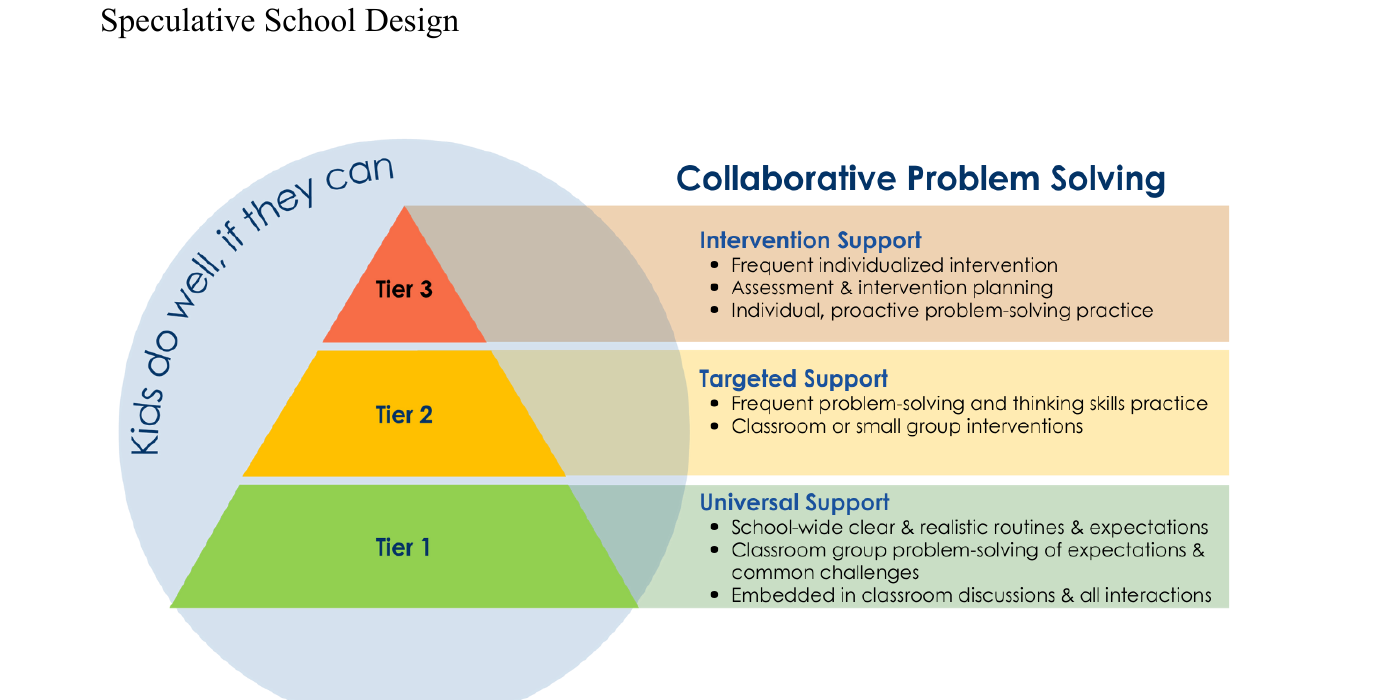
At Common Grounds, behavior is not treated as a separate issue from culture, teaching, or justice. The way a school responds to behavior tells students a lot about what kind of community it actually is. If the response is inconsistent, humiliating, or purely punitive, then the school teaches fear, silence, and hierarchy. If the response is clear, proactive, relational, and rooted in accountability, then the school teaches students how to live with other people in real ways.
That is why our school would use an MTSS/PBIS framework paired with restorative practices. PBIS gives the school a shared system for teaching expectations clearly, supporting students proactively, and responding consistently instead of randomly. But for me, the important thing is that it cannot just be about management. It has to be about protection, predictability, and dignity. The framework only works if it is paired with a deeper philosophy of care, equity, and repair.
Multiple Tiered Systems and Supports
Schoolwide Behavior Matrix
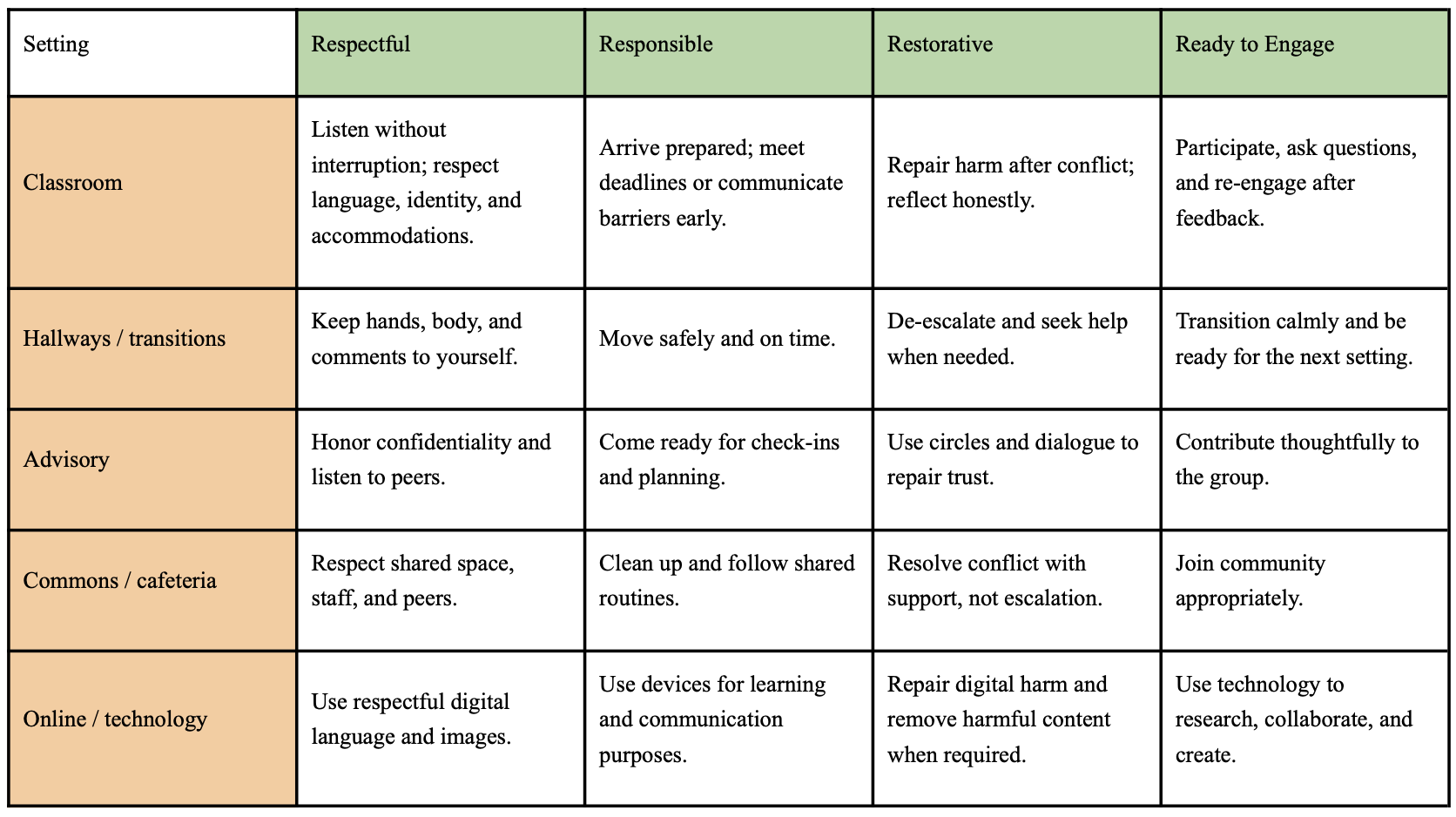
Our schoolwide behavior expectations are organized around four clear anchors: Respectful, Responsible, Restorative, and Ready to Engage. We chose these because they are simple enough to remember, but rich enough to teach across spaces. Students should know what these expectations look like in classrooms, hallways, advisory, communal spaces, and digital environments. They should not have to guess at the hidden rules of school.
That matters especially for students with disabilities, multilingual learners, and students who have been harmed by institutions before. Hammond (2015) emphasizes that trust and safety are tied to students' willingness to engage cognitively. If the environment feels unpredictable or shame-based, learning shuts down. That is one of the reasons clear and teachable structures matter so much to our learning community.
Restorative Discipline and Re-Entry
When students do break norms or cause harm, the response would not stop at punishment. We would not rely on detention as a default, and we would avoid exclusionary discipline whenever possible. Instead, responses would include reflection, mediated conversations, restorative dialogue, and structured re-entry. A consequence may still happen, especially if safety has been affected, but the consequence would never be the full story. Afterward, the school still has a responsibility to reteach expectations, repair relationships when possible, and help the student return to the community with support rather than stigma. That matters because justice in a school setting cannot just mean removal. It has to mean accountability with a pathway back.
For students who need more than universal supports, Common Grounds would move into targeted and individualized intervention through MTSS. Some students may need mentoring, check-ins, small-group support, or structured progress monitoring. Others may need an FBA and BIP that identify the purpose of the behavior, the missing skill, the replacement behavior to teach, and the adult responses needed to support success. This is important to me because it keeps us from acting like behavior is just defiance or attitude. Often, it is communication, stress, unmet need, or a skill that has not yet been fully developed. Freire (1970) reminds us that oppressive systems reduce people to objects to be controlled. Our school cannot do that. Even when students struggle, they still have to be treated as human beings who are capable of optimal reflection, repair, and growth.
We are intentional and understand our matrix is not just to hang expectations on the wall. It is to make them visible, teachable, and all around accessible. Teachers and staff would model expectations, revisit them regularly, and use a common language for correction and support. We are not assuming students automatically know how to function in every environment we put them in. That assumption is often deeply unfair, especially when schools punish students for not already knowing rules that were never clearly taught. Vygotsky (1978) helps here too: students grow into new forms of participation through guided support, practice, and social interaction. In other words, behavior is learned. So if we want students to participate in healthy school culture, then school culture has to teach them how.
At Common Grounds, we would also be explicit that our approach is proactive, not just rehabilitative. We are not waiting for harm to happen and then reacting. Community circles, advisory, predictable routines, and clear expectations all exist to build the relational foundation before conflict escalates. Restorative practices are not only for after something goes wrong. They are part of how trust is built in the first place. This is important because once a school only knows how to respond after breakdown, it has already failed to build the kind of culture students need.
References
Freire, P. (1970). [Pedagogy of the oppressed.](https://archive.org/details/pedagogyofoppres0000frei) Continuum.
Hammond, Z. (2015). [Culturally responsive teaching and the brain.](https://us.corwin.com/books/culturally-responsive-teaching-and-the-brain-2-272214) Corwin.
Ladson-Billings, G. (1995). [Toward a theory of culturally relevant pedagogy.](https://www.jstor.org/stable/1163320) American Educational Research Journal, 32(3), 465-491.
Noddings, N. (2005). [The challenge to care in schools: An alternative approach to education](https://www.tcpress.com/the-challenge-to-care-in-schools-2nd-edition-9780807745144) (2nd ed.). Teachers College Press.
Piaget, J. (1952). [The origins of intelligence in children.](https://archive.org/details/originsofintelli0000piag) International Universities Press.
Vygotsky, L. S. (1978). [Mind in society: The development of higher psychological processes.](https://www.hup.harvard.edu/books/9780674576292) Harvard University Press.
Center on PBIS. (n.d.). [What is PBIS?](https://www.pbis.org/pbis/what-is-pbis)
Institute of Education Sciences. (2024). [Teacher-delivered behavioral interventions in grades K–5.](https://ies.ed.gov/ncee/wwc/practiceguide/31) U.S. Department of Education.
Horner, R. H., Sugai, G., & Anderson, C. M. (2010). Examining the evidence base for school-wide positive behavior support. Focus on Exceptional Children, 42(8), 1–14.
Darling-Hammond, L., Schachner, A., Edgerton, A. K., et al. (2023). [Restorative practices and whole child approaches to school discipline: A research review.](https://learningpolicyinstitute.org) Learning Policy Institute.