One 'correct' way of speaking
Academic discourse is added to a student's repertoire — it never replaces their linguistic identity.
At Common Grounds, we refuse the idea that only one form of English, one discourse style, or one pathway should count as legitimate. This section of our team's design paper, authored by Annie, Sayo, and Emma, explains how we combat oppression and work toward social justice through language, access, co-teaching, and graduation pathways.
At Common Grounds, language is not treated as a barrier to overcome, but as a resource for thinking, learning, and belonging. Because our mission centers students as meaning-makers, we reject the idea that only one form of English, one discourse style, or one dialect should count as "academic" or legitimate in school. Instead, students are encouraged to use their home languages and language varieties as tools for processing ideas, communicating with others, and engaging in rigorous academic work. This approach reflects García's (2014) work on translanguaging, which argues that multilingual students learn more powerfully when they are able to draw on their full linguistic repertoires rather than being forced to separate or suppress parts of themselves.
In practice, this means instruction at Common Grounds will include translanguaging strategies, bilingual and multilingual texts, embedded language scaffolds, and opportunities for students to discuss, draft, and process in the languages that help them make meaning most effectively. English language development will no longer be isolated from content learning. Instead, students will develop English through meaningful participation in social studies, science, mathematics, literacy, and the arts. Teachers will help students move across discourse communities by explicitly teaching academic language while making it clear that academic discourse is something to be added to a student's repertoire, not something that replaces their existing linguistic identity. This approach also aligns with New York State's Culturally Responsive-Sustaining Education Framework, which emphasizes that schools should affirm students' linguistic identities and use those identities as foundations for learning rather than obstacles to it (New York State Education Department [NYSED], n.d.).
This commitment is also visible in the structure of our classrooms. Because every classroom includes both a general education teacher and a special education teacher, students encounter support as a normal part of school rather than something hidden or reserved for a select group. The expertise of both teachers is a collective resource, and any student may draw on either teacher for clarification, strategy support, language support, or help with accessing content. In this way, Common Grounds resists the idea that some students are the "real" students in a classroom while others are the "supported" students. Instead, support is part of the culture of learning itself. That same philosophy extends to schoolwide resources such as resource rooms, writing supports, language scaffolds, and academic intervention spaces, which are available to any student who needs them. This model reflects Universal Design for Learning, which emphasizes designing environments around learner variability from the start rather than waiting for students to "qualify" for access (CAST, 2024).
Academic discourse is added to a student's repertoire — it never replaces their linguistic identity.
Resource rooms, scaffolds, and intervention spaces are available to any student who needs them.
Two teachers in every room means support is the norm — not a signal that something is wrong.
Flexible grouping, translanguaging, and multiple entry points keep every student in the intellectual work.
At Common Grounds, rigor is not a privilege reserved for students who already know how to perform school successfully. It is a right. We do not believe that challenge should be rationed through rigid tracking systems that often reproduce inequities in race, language, disability, and class. Instead, our school is built on the idea that all students deserve access to meaningful, intellectually demanding work alongside the supports necessary to participate fully in that work. This reflects Hammond's (2015) argument that rigorous learning depends on culturally and cognitively responsive teaching, as well as Ladson-Billings's (1995) emphasis on academic success, cultural competence, and critical consciousness as interconnected rather than competing goals.
To enact this commitment, Common Grounds uses heterogeneous grouping, embedded honors structures, co-teaching, and flexible scaffolding rather than traditional ability tracking. All students will encounter challenging curriculum, but they will not be expected to enter it through a single narrow pathway. Teachers will offer multiple entry points into content, varied modes of participation, and multiple ways for students to demonstrate understanding. This is supported by UDL, which emphasizes reducing barriers while preserving challenge, and by culturally responsive-sustaining approaches that call on schools to stop confusing sameness with fairness (CAST, 2024; NYSED, n.d.).
The presence of two teachers in every classroom is especially important here. Co-teaching is not treated as a way to split students into visible groups of "general education" and "special education" learners. Rather, the general education teacher and special education teacher function as a shared instructional team whose expertise benefits the entire class. Either teacher may conference with students, reteach concepts, provide scaffolds, facilitate small groups, support writing or discussion, or extend learning for students ready to go deeper. This means the classroom itself is built around collective access. Supports are not restricted only to students with formal service plans, because needing support at a given moment is part of learning, not evidence of lesser ability. Resource spaces and intervention supports follow the same philosophy: they are open to any student who needs them, not only those who are officially identified. That design choice matters because schools often reproduce inequality by making help feel stigmatized, inaccessible, or conditional. When literacy is treated as a shared, disciplinary practice rather than a fixed ability, it becomes a tool for participation, critique, and access to power, rather than a mechanism that sorts students into who does and does not belong (Freire, 1970).
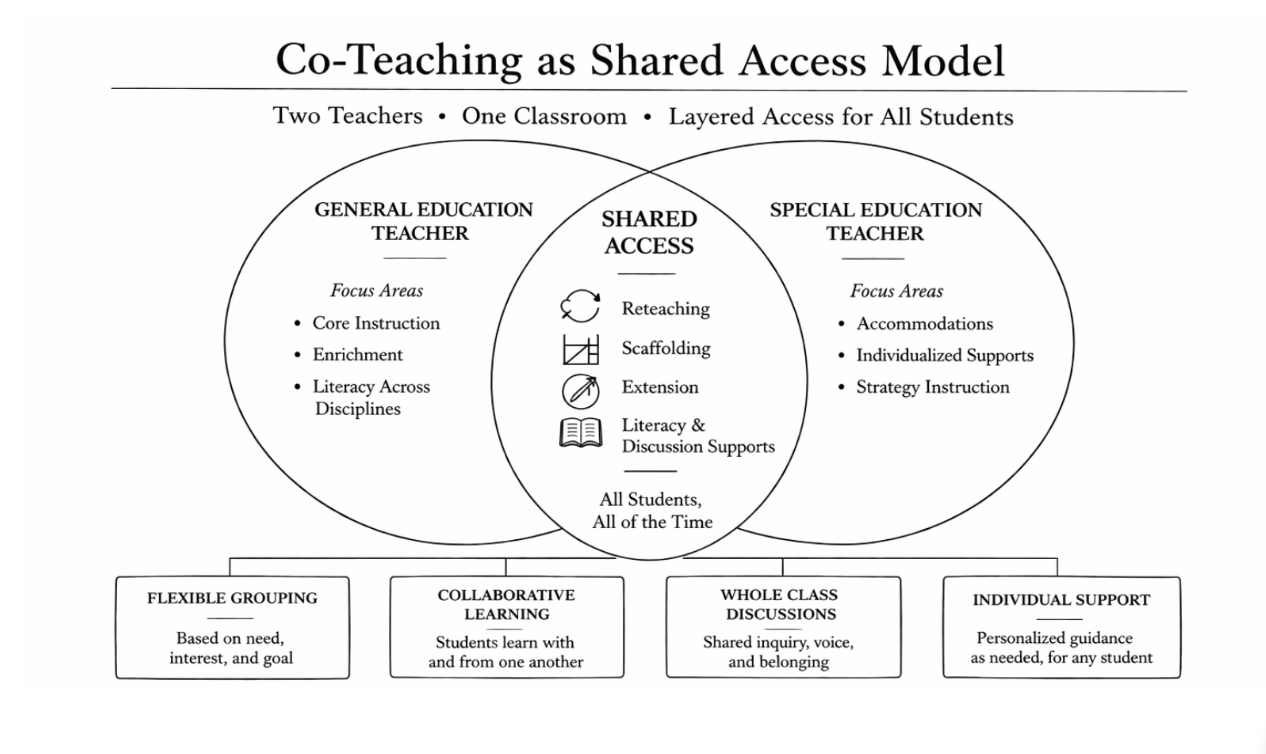
Two Teachers · One Classroom · Layered Access for All Students
To make sure these structures do not inherently reproduce the inequities they are meant to interrupt, Common Grounds will be accountable through schoolwide expectations rather than individual teacher preference. Teachers will collaborate in planning teams, examine student work together, and review participation, access, and achievement data across student groups to identify patterns of inequity. In other words, our anti-tracking model is not just about abolishing labels; it nurtures building a system where all students are assumed to be intellectually capable and where support is normalized as part of the path toward rigor.
At Common Grounds, graduation is not treated as a final checkpoint that only matters once a student begins falling behind. It is a long-term developmental process of helping students understand who they are, what they care about, what support they need, and how they want to move into adult life while learning how to access resources independently and innovatively. Because our mission emphasizes self-direction, critical engagement, with meaningful contribution to community, transition planning needs to begin early and must continue throughout high school (Test et al. (2009). Rather than waiting until the end of a student's school career to talk about the future, we design structures that make pathway planning part of the everyday culture of the school.
A major part of this is our Common Ground Communities structure. Students will remain with the same Common Ground Community and advisor from ninth through twelfth grade whenever possible. This continuity allows students to build deep relationships with one trusted adult and a stable peer community over time. It also makes transition planning more personal and accurate, because advisors come to know students' strengths, needs, goals, learning histories, and changing life circumstances in a sustained way. Instead of transition planning being reduced to disconnected meetings or compliance paperwork, it becomes part of an ongoing relationship. Advisors will help coordinate communication among teachers, counselors, service providers, families, and community partners while supporting students in setting goals, reflecting on growth, and planning for life after graduation. This aligns with research on school connectedness, which shows that students benefit academically and socially when they feel known, supported, and meaningfully connected to adults in school (Centers for Disease Control and Prevention [CDC], 2009).
Students at Common Grounds will move toward graduation through multiple pathways, including college-preparatory coursework, community-based learning, civic inquiry, and career-connected opportunities. For first-generation college students, this will include college application workshops, financial aid guidance, mentoring, and explicit instruction in navigating postsecondary systems. For students with disabilities, transition planning will be integrated with support services and future-oriented goal setting so that postsecondary planning includes self-advocacy, independent living, employment, community participation, and continued learning. This reflects the IDEA transition planning framework, which emphasizes preparing students for life beyond school in ways that are individualized and meaningful rather than generic.
If a student fails a class, Common Grounds does not treat that as the end of the story. Failure triggers support, not abandonment. Teachers, advisors, counselors, and support staff will work together to identify barriers, reteach content, create opportunities for revision, and design a plan that keeps the student connected to both learning and community. Summer school, if needed, will not function as a punitive holding space. Instead, it will include credit recovery, bridge programs, enrichment opportunities, and continued access to community and learning, especially for students with exceptionalities. Because our school operates as a community hub with year-round academic enrichment and achievement programming, support does not disappear when the regular academic year ends. This model reflects community school principles, which emphasize expanded and enriched learning time, integrated supports, and strong family/community connections as part of equitable school design (Learning Policy Institute, n.d.). In this way, graduation pathways, recovery, and enrichment are all part of our same vision: students are more likely to persist when school is rigorous, relational, accessible, and built around the belief that growth remains possible.
CAST. (2024). UDL guidelines 3.0. https://udlguidelines.cast.org/
Centers for Disease Control and Prevention. (2009). Fostering school connectedness: Improving student health and academic achievement. U.S. Department of Health and Human Services.
Freire, P. (1970). Pedagogy of the oppressed. Herder and Herder.
García, O. (2014). Theorizing translanguaging for educators. In C. Celic & K. Seltzer, Translanguaging: A CUNY-NYSIEB guide for educators.
Hamman-Ortiz, L., Gort, M., & Pontier, R. W. (2024). Cultivating a critical translanguaging space in dual language bilingual education. Journal of Language, Identity & Education. Advance online publication.
Hammond, Z. (2015). Culturally responsive teaching and the brain. Corwin.
Ladson-Billings, G. (1995). Toward a theory of culturally relevant pedagogy. American Educational Research Journal, 32(3), 465–491.
Learning Policy Institute. (n.d.). Community schools. https://learningpolicyinstitute.org/topic/community-schools
Moll, L. C., Amanti, C., Neff, D., & Gonzalez, N. (1992). Funds of knowledge for teaching: Using a qualitative approach to connect homes and classrooms. Theory Into Practice, 31(2), 132–141.
Monte-Sano, C., De La Paz, S., & Felton, M. (2014). Reading, thinking, and writing about history: Teaching argument writing to diverse learners in the Common Core classroom. Teachers College Press.
New York State Education Department. (n.d.). Culturally responsive-sustaining education framework. https://www.nysed.gov/crs/framework
Paris, D. (2012). Culturally sustaining pedagogy: A needed change in stance, terminology, and practice. Educational Researcher, 41(3), 93–97.
Paris, D., & Alim, H. S. (2017). Culturally sustaining pedagogies: Teaching and learning for justice in a changing world. Teachers College Press.
Test, D. W., Mazzotti, V. L., Mustian, A. L., Fowler, C. H., Kortering, L., & Kohler, P. (2009). Evidence-based secondary transition predictors for improving postschool outcomes for students with disabilities. Career Development for Exceptional Individuals, 32(3), 160–181. https://doi.org/10.1177/0885728809346960
Vescio, V., Ross, D., & Adams, A. (2008). A review of research on the impact of professional learning communities on teaching practice and student learning. Teaching and Teacher Education, 24(1), 80–91.